How to Increase Social Media Engagement: A Practical Guide
Discover practical tips, tools, and strategies on how to increase social media engagement and boost your reach and interactions.
Forget follower counts for a second. Let's talk about what really moves the needle: social media engagement. We're not just chasing likes here. We're talking about sparking real conversations and building a community that actually cares about what you have to say. That means earning meaningful shares, thoughtful comments, and those all-important saves that signal true brand loyalty.
Why Social Media Engagement Is Your Most Valuable Metric
Vanity metrics like follower numbers are easy to track, but they don't tell the whole story. Real engagement is the foundation of trust. It tells both the algorithms and your audience that your content is genuinely valuable and worth their time. Think of these interactions as proof that you've built a healthy, thriving community, not just a list of names.
Let's be honest, in a world where people crave authentic connection, just broadcasting ads doesn't cut it anymore. Knowing how to increase your social media engagement isn't just a "nice-to-have"—it's the core of any smart digital strategy. With the number of social media users now double the number of non-users, the opportunity to connect is massive.
The Shift from Reach to Relationship
It wasn't long ago that success was all about how many eyeballs saw your post. That game has completely changed. Today, platforms like Instagram and LinkedIn are built to reward content that creates conversation. A post with 100 comments will almost always outperform one with 1,000 likes and zero discussion because it shows a much deeper level of connection.
Engagement is your campaign’s pulse. Every like, comment, or share tells algorithms and audiences that your content is worth their time. It’s the clearest sign your audience is paying attention.
This means your main goal is to build relationships, not just rack up impressions. Every single interaction is a chance to strengthen that bond and turn a passive follower into a true brand advocate.
What Real Engagement Looks Like
Authentic engagement is all about quality over quantity. Sure, a like is a nice little nod of approval, but other actions carry far more weight and show that someone is truly invested in your brand.
- Comments and Replies: This is where the magic happens. Comments open up a direct line of communication, letting you answer questions, gather feedback, and show off the human side of your brand.
- Shares and Reposts: When someone shares your content, they're essentially giving you their stamp of approval. It’s powerful social proof that puts your brand in front of their network.
- Saves and Bookmarks: This is a huge win. A save tells you your content is so valuable that someone wants to come back to it later, positioning you as an indispensable resource in your niche.
If you nail these fundamentals—really understanding your audience, creating content that begs for a response, and actively nurturing your community—you'll build a foundation for growth that lasts. If you're looking for more ways to put this into practice, check out these expert tips and tricks to increase social media engagement.
Find Your Audience And The Platforms They Actually Use
Posting incredible content into an empty room is a surefire way to burn out. Before you even think about what to post, you have to get brutally honest about who you're posting for. This isn't a guessing game. It's about using the data you already have to paint a realistic picture of your ideal follower.
Think of this initial deep dive as the foundation of your entire engagement strategy. It's the bedrock that informs every caption you write, every visual you choose, and every single platform you decide to invest your time in.
This whole process is a chain reaction: it all kicks off with understanding your audience, which then dictates your content, and ultimately helps you build a community that actually cares.
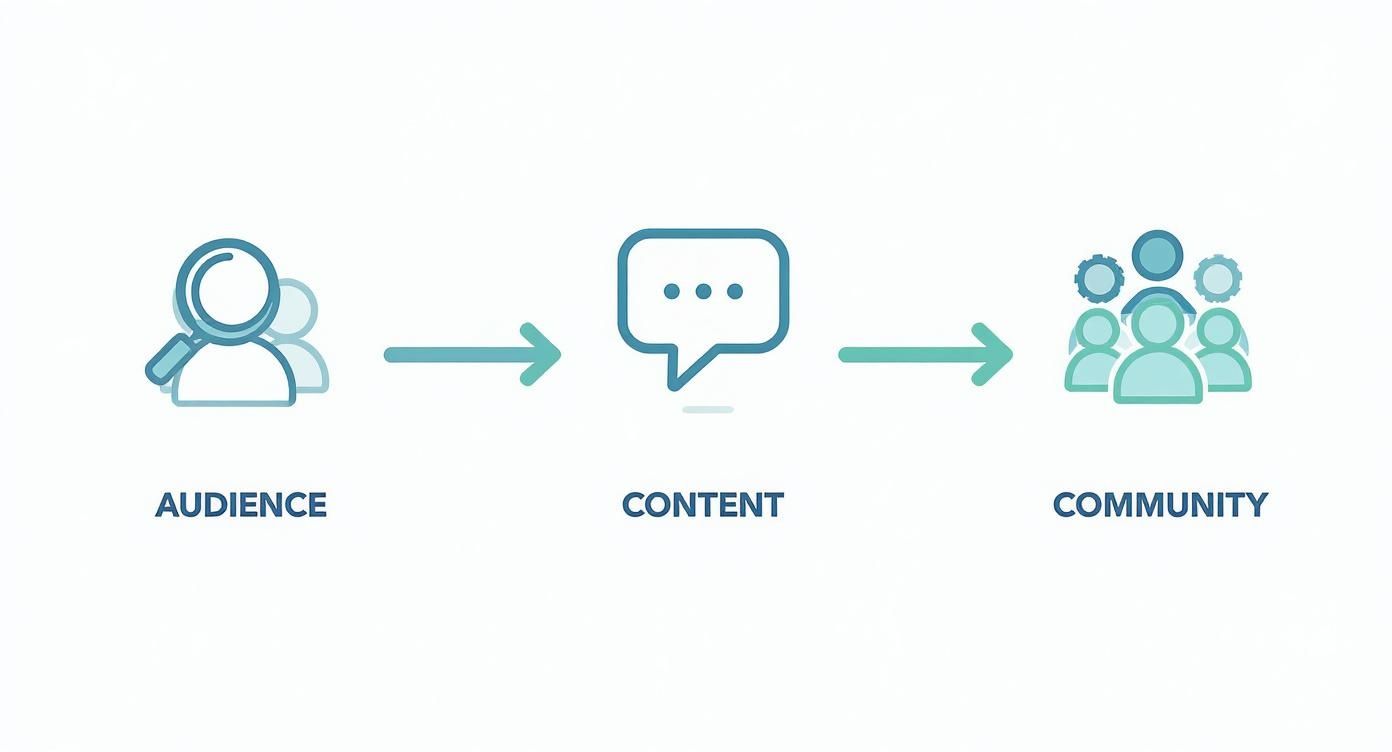
Without that solid audience foundation, your content and community-building efforts are just shots in the dark. You'll find it nearly impossible to genuinely increase your social media engagement.
Digging Into Your Existing Follower Data
Your current followers are a goldmine of information just waiting to be tapped. The native analytics tools on platforms like Instagram and Facebook offer a surprisingly granular look at who's already tuned in to what you're saying.
So, go ahead and open up your Instagram Insights or Facebook Audience Insights. Don't just glance at the top-line numbers—dig into the demographics.
- Age and Gender: Are you talking to Gen Z students or millennial parents? The slang, pop culture references, and overall tone you use need to match up.
- Location: Are your followers concentrated in a specific city or spread across the globe? This directly impacts your post timing and cultural relevance.
- Active Times: This one is pure gold. These tools show you the exact days and hours your audience is doomscrolling. Posting during these peak windows is the lowest-hanging fruit for getting more eyes on your content right away.
Knowing your audience is so much more than demographics. It's about understanding their online habits. When are they scrolling? What makes them stop? Answering these questions is the key to creating content they can't ignore.
Once you've got a baseline from your analytics, you can start layering on more detail. If you want to get super specific, check out our guide on the best times to post on Facebook for a platform-specific breakdown.
Building Actionable User Personas
A user persona is just a fancy term for a semi-fictional character you create based on your research. It represents your ideal follower, but it goes way beyond simple data points by digging into the motivations and frustrations that drive their behavior online.
Instead of a bland "our audience is women aged 25-34," a persona makes them feel real.
Let's meet "Eco-Conscious Emily":
- Who she is: A 29-year-old graphic designer living in a busy city.
- Her goals: She wants to live more sustainably but feels completely overwhelmed by all the information out there. She's looking for simple, practical swaps she can actually stick with.
- Her pain points: She's sick of preachy, guilt-trippy content. She wants inspiration, not a lecture.
- Her social habits: She unwinds in the evenings by scrolling through Instagram and Pinterest, looking for home decor and DIY ideas.
Just like that, you have a roadmap for your content. You know to create helpful, non-judgmental Instagram posts and beautiful, Pinnable guides, and you know to post them after work hours. Create two or three of these personas, and your entire content strategy will suddenly have a laser focus.
Choose Your Platforms Wisely
This is one of the biggest mistakes I see brands make: trying to be everywhere at once. It's a recipe for disaster that stretches your resources thin and results in mediocre content across the board. The goal isn't to be present everywhere; it's to dominate one or two channels where your target audience lives.
Look back at your personas. Where are they really spending their time?
- If you're after B2B professionals, LinkedIn is your home base. No questions asked.
- For a highly visual brand targeting a younger crowd, TikTok and Instagram Reels are where you need to be playing.
- If your audience craves deep dives and detailed tutorials, YouTube might be your perfect match.
Focusing your energy lets you master the quirks of each platform's algorithm and learn the unspoken rules of its community. This concentrated effort will do far more to boost your engagement than spreading yourself thin across five different networks. Master your main channels first, build a loyal following, and then you can think about expanding your territory.
Create Content That People Can't Help But Interact With
 Alright, you know who you’re talking to and where they hang out online. Now the real fun begins. It’s time to stop just posting and start creating content that actually pulls your audience into a conversation.
This is the moment you go from being a broadcaster to a community builder. And it all boils down to the types of content you choose. Forget posting just to fill the calendar. Every single thing you publish should be designed to make interaction feel completely irresistible.
Spark Instant Interaction With Easy Formats
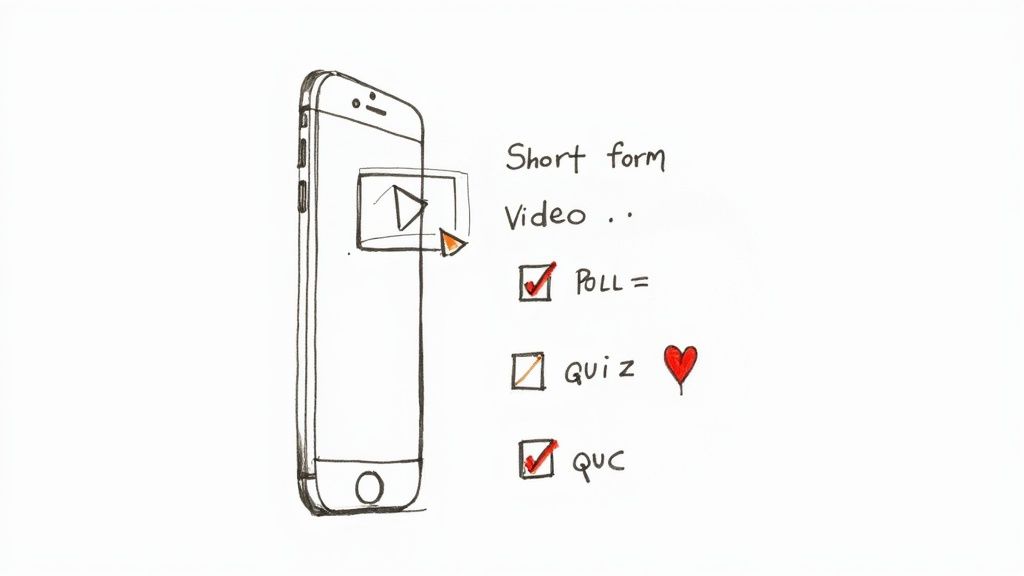
Honestly, some of the most effective ways to get people talking are also the simplest. These formats work because they have an incredibly low barrier to entry—someone can join in with just a quick tap.
- Polls and Quizzes: There's a reason platforms like Instagram Stories and X have built-in poll features: they flat-out work. Ask fun, simple questions like "This or That?" related to your products, or run a quick quiz to see what your audience knows about your industry.
- "Ask Me Anything" (AMA) Sessions: Hosting an AMA on Instagram Stories or a live stream is a fantastic way to show transparency and give your audience a direct line to you. It builds a ton of trust and lets you answer their most pressing questions in real-time.
- Fill-in-the-Blanks: You'd be surprised how well a simple prompt like, "My favorite way to unwind on a Friday is ______" performs. It’s a low-effort way for people to share a little piece of their world, and it gets the comments flowing.
Think of these as quick wins. They give your engagement an immediate boost and send a strong signal to the algorithm that people are actively vibing with your account.
Master the Art of Scroll-Stopping Short-Form Video
With roughly 5.42 billion people on social media, attention is your most valuable currency. The average person scrolls through about 6.83 different social networks a month, and with 78% of people preferring short videos to learn about products, you can't afford to ignore platforms like Reels and TikTok.
Making great short-form video isn’t about having a huge budget; it’s about understanding what makes someone stop their thumb mid-scroll.
- The Hook Is Everything: You have less than three seconds. Seriously. Start your video with a bold claim, a burning question, or a visual that makes people do a double-take. "Three mistakes you're making with your morning coffee" will always beat "Here's how to make coffee."
- Deliver Value, Fast: Whether your goal is to entertain, educate, or inspire, get straight to the point. Use quick cuts, on-screen text, and trending audio to keep the energy up and make your content easy to digest.
- End With a Clear CTA: Tell people exactly what you want them to do next. A simple "Share this with a friend who needs it" or "Comment your favorite tip below" gives viewers a clear, easy next step.
If you really want to level up your video game, our guide on social media video marketing is packed with tips to sharpen your skills.
Make Your Audience the Hero with UGC Campaigns
User-generated content (UGC) is the gold standard of social proof. When your followers post about your brand, it's not just another interaction—it’s a powerful endorsement. A UGC campaign is your way of encouraging this and putting your audience in the spotlight.
Kick things off with a simple prompt and a unique hashtag. For example, a local coffee shop could run a #MyMorningMug campaign, asking followers to share photos of their daily coffee ritual. Then, feature the best submissions on your own feed, making sure to tag and credit the original creators.
User-generated content does more than just fill your content calendar. It builds a powerful sense of community and shows potential customers that real people love and use your products.
This strategy gives you a constant stream of authentic content while making your followers feel seen and celebrated. For those looking to push the creative envelope, you could even explore newer tactics like learning how to create AI influencers to give your brand a unique voice.
Write Captions That Compel and Convert
The visual might stop the scroll, but the caption is often what seals the deal and gets the comment. A great caption doesn't just describe the image; it opens a loop that your audience feels an urge to close.
Always start with a hook—that first line is everything. Follow it up with a relatable story, a genuinely helpful tip, or a surprising fact.
Most importantly, end with a direct call-to-action that encourages comments, not just likes. Ditch generic questions like "What do you think?" and get specific.
Weak CTA vs. Strong CTA
| Weak Call-to-Action | Strong Call-to-Action | | :--- | :--- | | "Thoughts?" | "What's the #1 challenge you're facing with this?" | | "Let us know in the comments!" | "Share your favorite memory from a road trip below." | | "Hope you like our new product." | "Which new feature are you most excited to try?" |
When you're intentional about your content formats and your captions, you create an environment where interaction becomes second nature. That's how you turn passive scrollers into a thriving community.
Turn Your Followers Into A Thriving Community
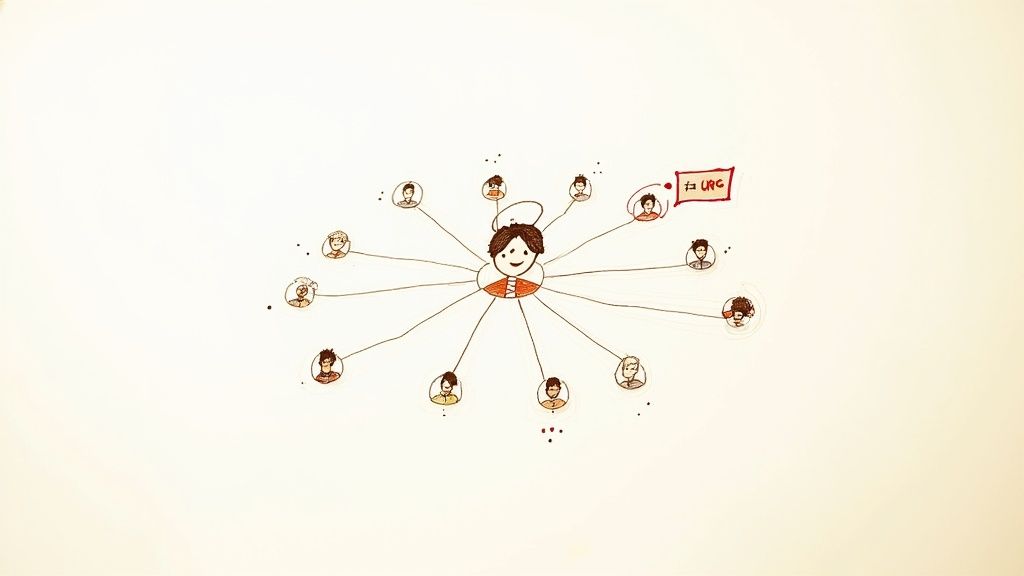
Great content gets the conversation started, but what you do after you post is what really turns passive followers into a genuine community. Engagement is a two-way street, after all. Just broadcasting posts and hoping for the best is a surefire way to get lost in the noise. To truly see your engagement numbers climb, you have to actively nurture the space you’re creating.
Think of your social media profile like a party you’re hosting. You wouldn't just turn on the music and hide in a corner, right? You’d be out there greeting guests, making introductions, and ensuring everyone feels welcome. Your online community deserves that same level of attention.
Show Up and Be Human
The fastest way to kill any momentum is to ignore the people who engage with you. When someone takes the time to leave a thoughtful comment or send a DM, they're looking for a connection. Responding promptly—and with personality—proves there's a real person behind the account who's actually listening.
And please, don't just send a generic "Thanks!" to every comment. Personalize your replies. Mention something specific they said or ask a follow-up question. This simple act can turn a one-off interaction into a memorable conversation, building loyalty one reply at a time.
Responding to comments and DMs isn't just good manners; it's a powerful signal to the algorithm. When platforms see real, back-and-forth conversations happening, they recognize your content as valuable and are more likely to show it to a wider audience.
Don’t be afraid to let your brand's personality shine. Are you witty and humorous? Or are you more supportive and educational? A consistent tone of voice makes your brand feel authentic and, most importantly, relatable.
Handle All Feedback With Grace
Community management isn’t just about soaking up the praise. How you handle negative feedback and criticism is arguably more important. A negative comment isn't a crisis; it's an opportunity to show your brand's integrity and commitment to getting things right.
Here’s a simple framework for navigating those tricky comments:
- Acknowledge and Validate: Start by showing you hear their frustration. A simple, "I'm so sorry to hear you had this experience," can go a long way.
- Take It Offline: For more complex issues, offer to solve the problem privately. Something like, "Please send us a DM with your order number so we can look into this for you," protects their privacy and shows you're taking them seriously.
- Never Delete (Unless It's Spam): Deleting legitimate criticism will almost always escalate the situation and shatter trust. Transparency is everything.
When you respond publicly with empathy and professionalism, your entire audience sees that you value feedback and stand by your customers. This builds incredible trust and can even turn a frustrated user into a loyal fan.
Actively Celebrate Your Audience
Responding to comments is crucial, but proactive engagement is where you build a true tribe of advocates. This means going beyond your own page to celebrate the very people who make up your community.
Start by actively engaging with your followers' content. A simple like or a thoughtful comment on their own posts can make a huge impression. It shows you see them as more than just a number in your follower count.
Next, make a habit of celebrating your biggest fans. You can do this by:
- Featuring User-Generated Content (UGC): Regularly share and repost photos, videos, or testimonials from your followers (with their permission, of course!). This is powerful social proof and makes your audience feel seen and valued.
- Giving Shout-Outs: Create a weekly or monthly series where you highlight a "fan of the week." Tag them and explain why you appreciate their support.
Actions like these transform passive followers into active participants and brand champions. When people feel like they’re truly a part of something, they are far more likely to engage, share your content with their networks, and advocate for your brand on their own.
Drive Action Using Urgency And Anticipation
Beyond just starting conversations, one of the best ways to get people to act on social media is to tap into some basic human psychology. Two feelings work like a charm for getting an immediate response: anticipation and urgency.
When your audience feels like time is running out or that something exciting is just around the corner, they’re way more likely to stop scrolling and actually pay attention.
This is where a visual tool like a countdown timer really shines. It turns a boring, static announcement into a dynamic, live event. Suddenly, your followers have a real, tangible reason to engage right now. A simple ticking clock can be the difference between someone passively scrolling by and actively participating.
Build Buzz for Launches and Events
Got a new product dropping or a live webinar coming up? A countdown timer is your new best friend for building momentum. Instead of a flat "coming soon" post, you create a living, visual reminder that builds excitement with every passing day. This simple trick turns a one-off announcement into a multi-day engagement campaign.
Try pinning a post with a countdown timer to the top of your Facebook page. You can also embed one on your website so it’s the very first thing visitors see. This constant visibility keeps your event top-of-mind and encourages people to share it as the big day gets closer.
Here’s an example of a clean, embeddable countdown timer that you can customize for any event or offer.
This visual cue instantly communicates the deadline and creates a sense of importance that a text-only post just can't match.
Create Scarcity for Sales and Offers
Nothing gets people moving quite like the fear of missing out (FOMO). When you're running a flash sale or a limited-time offer, a countdown timer is the ultimate tool for dialing up the urgency. It's been shown that creating that sense of urgency can seriously boost conversion rates by nudging indecisive followers to finally make a purchase.
By visually showing that time is running out, a countdown timer kills the "I'll come back to it later" mindset. It forces an immediate decision, which is exactly what you need to turn a passive scroller into a customer.
Think about these powerful ways to use it:
- Flash Sales: Announce a 24-hour sale with a timer ticking down every second. That shrinking timeframe pushes people to click right away.
- Limited Stock Alerts: Use a timer to show how long a low-stock item will be available, prompting quick purchases before it’s all gone.
- Early-Bird Pricing: Count down to the end of a special discount for an event or course. This rewards the early birds and drives those crucial initial sign-ups.
We've put together a table to break down a few more scenarios where a countdown timer can make a real difference in your engagement strategy.
Countdown Timer Applications for Social Media Engagement
| Use Case | Primary Goal | Platform Example | Key Benefit | | :--- | :--- | :--- | :--- | | Product Launch | Build Anticipation | Instagram Stories sticker | Keeps audience hyped and top-of-mind | | Flash Sale | Drive Immediate Sales | Facebook Pinned Post | Creates urgency with a visual deadline | | Webinar Registration | Increase Sign-ups | Embed on Website Landing Page | Motivates action before spots fill up | | Contest/Giveaway | Boost Participation | Twitter Post | Encourages last-minute entries and shares | | Seasonal Offer | Capitalize on Timeliness | Email Newsletter | Increases click-through rates on offers |
As you can see, the applications are pretty versatile, targeting different goals across various platforms. The core idea remains the same: give people a compelling, time-sensitive reason to act.
This tactic is a cornerstone of smart sales psychology. For a deeper dive, you can learn more about how to create urgency in sales and apply those principles directly to your social campaigns. By weaving these time-sensitive triggers into your content, you’ll not only figure out how to increase social media engagement but also see a direct impact on your bottom line.
Measure What Matters to Fine-Tune Your Strategy
You can't fix what you can't see. Pumping out great content and chatting with your followers is one thing, but understanding what actually works is a whole other ball game. To really move the needle on your social media engagement, you have to look past the flashy numbers like likes and follower counts. The real gold is in the data that shows a genuine connection.
This means you need to start focusing on the metrics that signal your content is truly hitting home. These are the data points that reveal intent and value, giving you a much clearer picture of what’s resonating with your audience.
The Metrics That Actually Signal Engagement
Let's ditch the vanity metrics for a second. If you want to understand what's driving real interaction, these are the KPIs you need to obsess over:
- Engagement Rate Per Reach: This is your truth serum. It shows you the percentage of people who saw your post and actually cared enough to interact. It’s the clearest way to see how compelling your content is, especially to people who don't already follow you.
- Saves: A save is a huge compliment. It means your content was so valuable that someone tucked it away to come back to later. This is a massive indicator that you're delivering high-quality, genuinely useful information.
- Shares: When someone shares your post, they're putting their own reputation on the line to vouch for you. This is the digital version of word-of-mouth, and it’s pure fuel for organic growth.
- Comment Sentiment: Don't just count comments; read them. Are people excited? Confused? Happy? Understanding the feeling behind the words gives you qualitative insights you can't get from a dashboard.
It also pays to know the lay of the land. For B2B folks, for example, LinkedIn is king with an average engagement rate of 6.50%, while Facebook trails a bit at 5.07%. Knowing this stuff helps you set realistic goals. You can find more useful stats in this social media marketing report on dreamgrow.com.
Data-driven iteration is the secret to staying on top. Don't just post and pray; analyze what happened, learn from it, and tweak your approach. Your audience's behavior is the only roadmap you need.
A Simple Playbook for A/B Testing
Once you know which numbers matter, you can start running small experiments to improve them. A/B testing isn't just for landing pages—it’s a ridiculously powerful tool for social media. The idea is simple: change one thing at a time to see what your audience really wants.
Here are three easy tests you can run this week:
- Content Formats: Post the same core message, but once as a carousel and once as a single image. Does one format consistently rack up more saves or spark better conversations?
- Post Times: Take a similar piece of content and post it on the same day but at wildly different times, like 9 AM versus 5 PM. Dive into your analytics and see which time slot got that initial burst of engagement.
- Caption Styles: Try a longer, story-driven caption against a short, punchy one that gets straight to the point. Which one gets people talking in the comments?
By running these little experiments all the time, you stop guessing and start knowing. This constant cycle of testing and learning is how you adapt to algorithm curveballs and keep your content fresh, ensuring your strategy keeps working for the long haul.
Your Top Social Media Engagement Questions, Answered
Even the sharpest social media managers run into the same questions over and over. Let's be honest, navigating the quirks of each platform can feel like you're trying to hit a moving target in the dark.
I get it. You've got a strategy, but the day-to-day execution brings up new challenges. Let's clear the air and tackle some of the most common questions I hear with some straight-up, actionable advice.
"Seriously, How Often Should I Be Posting?"
Ah, the classic "it depends" question. But that's a cop-out, isn't it? While there’s no single magic number, the real answer is all about high-quality consistency. Your audience would much rather see two killer posts a week than seven forgettable ones.
Still, you need a place to start. Think of these as your baseline, then adjust based on what your own data tells you:
- Instagram (Feed): Aim for 3-5 times a week.
- Instagram Stories: Go for it daily. Use those interactive stickers like polls and quizzes to keep things fresh.
- Facebook: 1-2 times a day usually hits the sweet spot.
- LinkedIn: 3-5 times a week is perfect for the professional crowd.
- X (formerly Twitter): This one moves fast. Plan for 3-5 posts a day.
Treat these as a starting point. Keep a close eye on your analytics. If you post twice in one day and the second one always tanks, that’s your audience telling you to pull back. The goal is to find a rhythm that you can actually maintain without your content quality taking a nosedive.
"Should I Care More About Reach or My Engagement Rate?"
This one’s easy: engagement rate is king. While reach—how many eyeballs see your post—feels good for brand awareness, it's really just a vanity metric on its own. A healthy, connected community is where the real value is.
Think about it this way: a post that reaches 10,000 people but only gets 50 likes has a measly 0.5% engagement rate. Yikes. Compare that to a post reaching just 1,000 people that pulls in 100 likes—that's a stellar 10% engagement rate.
The second scenario is always more valuable. A high engagement rate is a massive signal to the algorithms that your content is good stuff. In turn, they'll often reward you with more organic reach down the line. Focus on starting conversations, and the reach will naturally follow.
"Help! My Post Is a Total Flop. What Can I Do?"
It happens to all of us. You craft what you think is a perfect post, hit publish, and… crickets. Don't just delete it in shame! You can absolutely breathe some new life into an underperforming post.
First, give it a second chance by sharing it to your Instagram Stories. This is your secret weapon. Add a poll or a question sticker to get a different kind of interaction going and drive some fresh eyes back to the original post.
Another pro move? Jump into the comments yourself and drop a thoughtful, open-ended question to get the ball rolling again. You could even tag a relevant account or a loyal follower who you think would have something great to add. Sometimes all it takes is a little nudge to restart the conversation.
Ready to build that buzz we've been talking about? Creating a sense of urgency and anticipation is one of the best ways to get people talking. You can build excitement for your next launch, event, or flash sale with a custom countdown timer.
With the Countdown Timer App, it takes just minutes to design and publish a live, auto-updating timer directly to your Facebook page or website. Give it a try for free and watch your engagement climb: https://www.countdown-timer.app