
A Modern Product Launch Marketing Strategy
Discover a modern product launch marketing strategy. Learn how to build buzz, execute a flawless launch, and sustain momentum with actionable advice.

A successful product launch isn't something that just happens on launch day. The real magic, the stuff that makes or breaks your success, happens months before anyone even sees your "buy now" button. This is the pre-launch phase.
It’s all about laying the groundwork—deep market research, nailing your product positioning, and building an early tribe of fans. Getting this right means every bit of marketing you do later will be sharper, more efficient, and actually hit the mark.
Building Your Pre-Launch Strategic Foundation
It's so tempting to jump straight to the flashy stuff. I get it. You want to design clever ads, write witty social media posts, and see the hype build. But the launches that truly explode are built on a solid foundation of careful, strategic work that happens behind the scenes.
Think of the pre-launch phase as the place where you win or lose the game before it even starts. It’s less about making noise and more about proving your product deserves to exist in the first place. This process is what turns a cool idea into a solution that plugs a real gap in the market.
Modern launches aren't just thrown against the wall to see what sticks. They follow a deliberate, step-by-step process to get the biggest bang for your buck. It all starts with digging into the market through surveys, interviews, and snooping on your competition to find customer pain points and overlooked opportunities. This intel is gold—it shapes your positioning and messaging, helping you craft a value proposition that makes you the obvious choice.
Uncovering Real Customer Pain Points
First things first: you need to get past the basic demographics and really understand the mindset of your target audience. What are their daily frustrations? Their unmet needs? What "jobs" are they trying to get done that your product could help with?
What problems are keeping them up at night? And what clunky workarounds are they using right now? Answering these questions is how you create something people don't just want, but genuinely need.
Here's how to get those answers:
- Conduct In-Depth Interviews: Actually talk to people. Aim for at least 10-15 potential customers. Ask open-ended questions about their challenges, not just what they think of your idea.
- Analyze Online Communities: Become a fly on the wall in places like Reddit, private Facebook groups, or niche industry forums. Look for the same questions and complaints popping up over and over again.
- Survey Your Waitlist: If you've already started collecting emails (and you should!), send out a survey to validate the pain points you've identified and see how badly they need a fix.
This whole process can be broken down into three core pillars: first you research the market, then you position your product within it, and finally, you validate that you're on the right track.
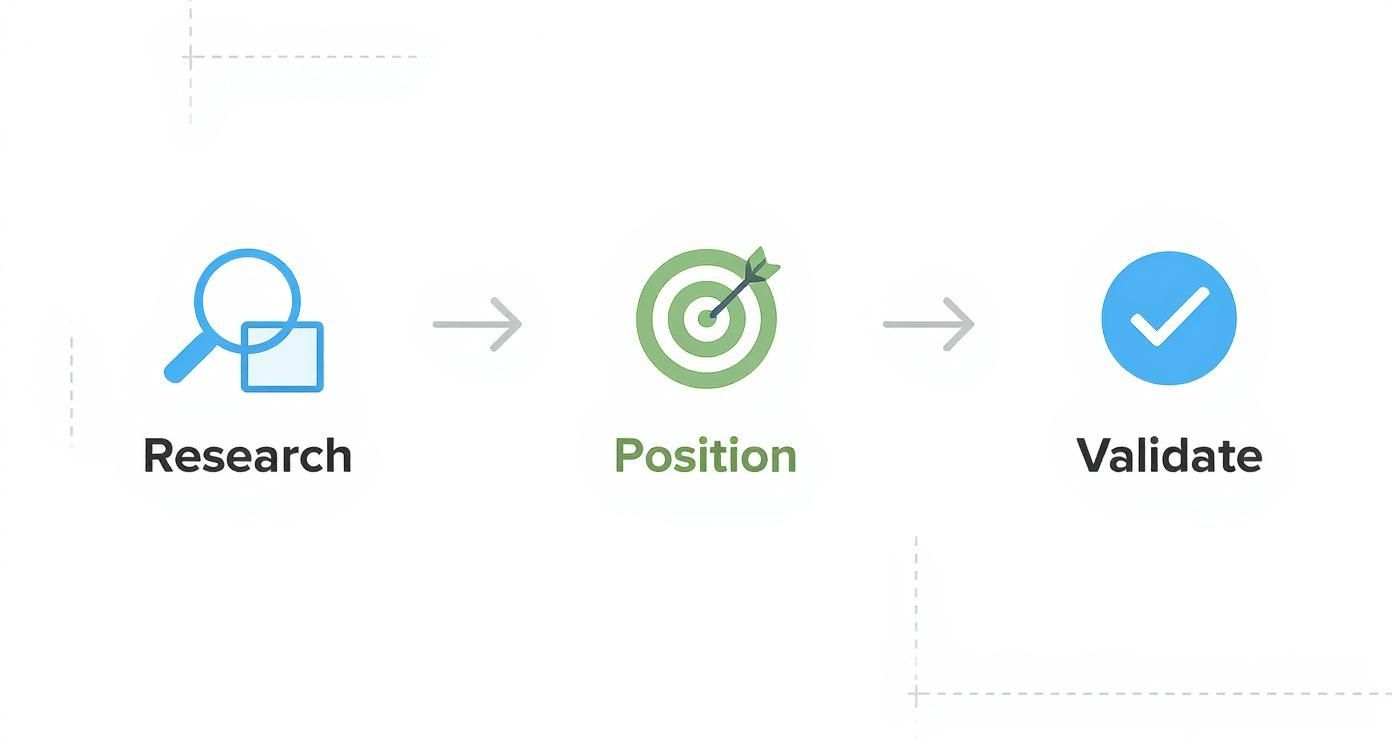
Each step flows into the next, taking you from a vague understanding of your customer to a rock-solid confirmation of your product-market fit.
Crafting Your Value Proposition and Positioning
Once you have those deep customer insights, you can finally figure out where your product fits in the bigger picture. Your positioning statement is your internal North Star—it clarifies your unique spot in the market. This isn't a catchy tagline for your homepage; it's a strategic declaration for your team.
A strong positioning statement answers four key questions: Who is the target customer? What is their core problem? What is our unique solution? And why are we better than the alternatives?
Your positioning then gives birth to your value proposition—the clear, compelling promise of value that you make to your customers. It should be the very first thing someone understands when they land on your site. Remember Dropbox’s early message? “Your files, anywhere.” Simple, benefit-driven, and you got it instantly.
For a great deep-dive into this whole process, check out this founder's guide on how to launch a new product.
Before you go all-in on your pre-launch strategy, it's critical to have a clear roadmap. The table below breaks down the essential activities and why each one matters.
Essential Pre-Launch Activities and Their Objectives
| Activity | Primary Objective | Key Metrics to Track | | :--- | :--- | :--- | | Market Research | To understand customer needs, pain points, and the competitive landscape. | Survey completion rates, interview insights, competitor feature matrix. | | Audience Definition | To create detailed buyer personas for targeted messaging. | Persona accuracy feedback, website traffic demographics. | | Positioning & Messaging | To craft a unique value proposition that resonates with the target audience. | Message clarity scores (from surveys), A/B test results on landing pages. | | MVP Development | To build a basic product version to test core assumptions and gather feedback. | Early adopter sign-ups, user feedback volume, pre-order numbers. | | Community Building | To create a group of early evangelists and generate initial buzz. | Waitlist sign-ups, social media engagement, email open/click rates. |
Treat this table as your checklist. Nailing each of these activities ensures you're building on solid ground, not just wishful thinking.
Validating Demand with a Lean MVP
Before you sink a ton of cash into development and marketing, you have to prove that people will actually open their wallets for your solution. This is where the Minimum Viable Product (MVP) comes in. It’s the most stripped-down version of your product that still solves the core problem for your earliest customers.
The goal isn't perfection; it's learning. An MVP could be a simple landing page with a "Pre-Order" button, a basic prototype, or even a "concierge" service where you provide the solution manually. You're just trying to test your biggest assumptions with the smallest possible investment. Success here isn't about huge sales numbers—it's about getting priceless feedback and confirming that real demand exists.
This early validation also helps you build a community of evangelists who feel like they're part of your journey. Nurturing these first fans is an incredibly powerful way to generate authentic buzz. As you get closer to launch, you'll need to build excitement on social media; our guide on how to use a Facebook countdown to increase brand awareness has some practical tips for just that. All this foundational work makes sure every dollar you spend later on is put to good use.
Creating Pre-Launch Buzz That Builds Anticipation
With your strategy locked in, it’s time to get your hands dirty. A killer product launch isn’t just about having a great product; it’s about turning quiet anticipation into a real, tangible buzz that people can feel. This isn’t about making random noise. It's about carefully building a story that pulls people in and makes them desperate to know what’s next.
The real goal here is to make your audience feel like they're on the inside track—part of an exclusive club that knows about something amazing before anyone else. That feeling of being in the know is what fuels early engagement and builds a powerful wave of momentum leading up to launch day.
Igniting Curiosity with Teaser Campaigns
A good teaser campaign is all about the slow burn. You don't just drop all the info at once. Instead, you drip out strategic little breadcrumbs that grab attention but leave your audience hungry for more. This methodical reveal is how you stay top-of-mind.
Think of it like a mini-series for your product. Every email, social media post, or short video is another episode building on the last. You might start by hinting at a problem you're about to solve, then show behind-the-scenes glimpses of the solution, and finally, reveal the product itself.
This staggered approach is gold for email marketing. A solid pre-launch email sequence could look something like this:
- Email 1 (The Hint): Kick things off by announcing that something big is on the horizon. Don't mention the product—focus entirely on the problem it solves.
- Email 2 (The Sneak Peek): Share some behind-the-scenes action, like a design sketch or a quick video of the team hard at work. It makes the whole journey feel more personal.
- Email 3 (The Feature Reveal): Pull back the curtain on one key feature or benefit that directly smashes the pain point you mentioned in the first email.
- Email 4 (The Final Countdown): Drop the official launch date and time. This gives your audience a clear call to action: mark your calendars.
Doing it this way transforms your launch from a single, forgettable announcement into an event that unfolds over time.
Harnessing Urgency with Countdown Timers
Nothing creates anticipation quite like a ticking clock. Countdown timers are a seriously powerful psychological tool that creates a real sense of urgency and scarcity. They’re not just a gimmick; they are a visual anchor for your launch, constantly reminding your audience that time is running out.
For example, using a tool like the Countdown Timer App lets you pop a dynamic, auto-updating timer right on your website or, even better, in an organic Facebook post. A timer placed on your waitlist landing page can be the difference between a visitor signing up or clicking away.
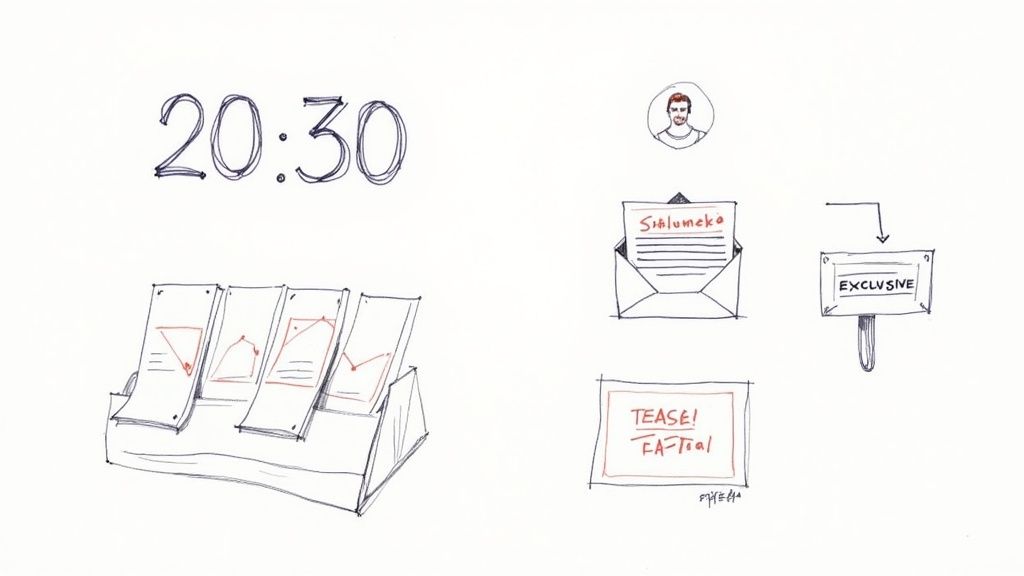
This simple visual cue turns a date on the calendar into an immediate, actionable event that people feel compelled to watch.
The trick is to weave these timers into all your pre-launch materials. When the countdown becomes a central part of your campaign, it gives all your promotional activities a single, exciting focal point. For more ideas on this, check out our guide on creating a countdown for a product launch on Facebook.
Building Authentic Hype with Influencers
These days, an authentic voice from a real person often carries way more weight than a brand shouting about its own product. Getting the right influencers on board can give your pre-launch campaign the social proof it needs to really take off. But how you approach them is everything.
Forget about just paying for a one-off sponsored post. The real magic happens when you build genuine relationships. Give key influencers early access, actually listen to their feedback, and let them share their honest-to-goodness experience with their audience.
One of the best ways to get those authentic early reviews is through product seeding. If you're new to the concept, this is a great resource for understanding what product seeding is and why it works. Basically, you gift your product to a hand-picked list of influencers with zero obligation to post. This lets them discover it on their own terms, leading to much more genuine content.
The unboxing videos, tutorials, or simple Instagram stories they create feel far more trustworthy to their followers. This isn't just advertising; it's co-creating buzz. It makes your launch feel less like a corporate announcement and more like a community-backed event, building a wave of excitement that will crash down perfectly on launch day.
Executing a Cohesive Multi-Channel Launch Day
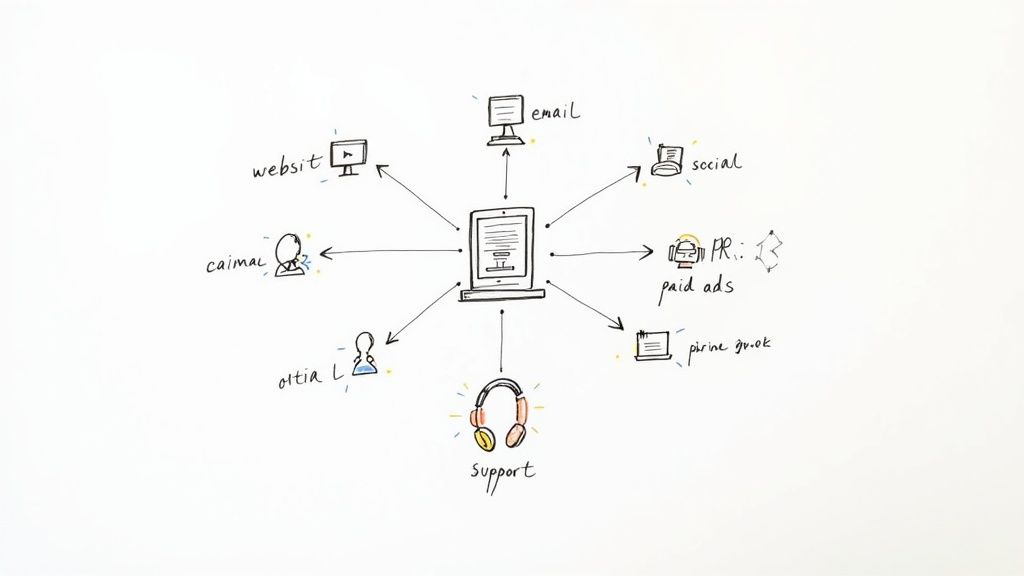
Launch day is the main event. It’s the moment all your planning, hype-building, and hard work finally comes together. Success now hinges on hitting "go" across every single channel at the same time. This isn't about ticking off a list of siloed tasks; it's about creating one big, unified wave of communication that makes your launch feel totally inescapable to your ideal customers.
Think of it as conducting a symphony, not just letting the band play whatever they want. Every email, social post, website banner, and ad needs to sing the same tune. This coordinated push reinforces your message and guides people straight to the "buy now" button, building trust and driving immediate action.
Aligning Your Messaging for Maximum Impact
Consistency is everything on launch day. Your audience will bump into your product in multiple places—maybe they'll see an Instagram ad, get an email an hour later, and then finally click through to your website. If the message, tone, or offer feels different on each platform, you create confusion and lose credibility.
Before you push the big red button, make sure every team member has access to a centralized "launch day source of truth." Seriously, this is a lifesaver. This simple document should include:
- Finalized Core Messaging: The main value prop and key benefits, locked and loaded.
- Official Visuals: All the approved product shots, ad creative, and banners. No rogue graphics allowed.
- Launch-Specific Offers: Any special discounts, bundles, or bonuses for early birds.
- Key Calls-to-Action (CTAs): The exact wording to use, like "Shop the Collection" or "Start Your Free Trial."
This one step prevents the small slip-ups that can make a great launch feel disjointed. It guarantees that whether someone finds you through a press feature or a TikTok video, their experience is seamless.
A critical mistake is treating launch day as a checklist of separate channel activities. Instead, view it as a single, unified conversation happening everywhere your customer is. The magic is in the cohesion.
Activating High-Impact Social Commerce Channels
Modern launches live and die by instant discovery and easy purchasing. That's why social commerce platforms like Instagram and TikTok are your best friends. These aren't just for brand awareness anymore; they are powerful sales drivers. On launch day, your social media feeds should basically transform into shoppable storefronts.
For instance, use Instagram Shopping to tag your new product directly in your posts, Reels, and Stories. This lets people go from seeing your product to adding it to their cart in just a couple of taps, which is a game-changer for reducing friction. Over on TikTok, you could partner with a few creators for a "Live Shopping" event where they demo the product and answer questions in real-time, driving sales right inside the app.
And those countdown timers you used to build hype? They get a new job on launch day. Now, they're all about creating urgency for your limited-time launch offers. Our guide on customizable countdown clocks shows you exactly how to tweak the visuals for this next phase.
Preparing Your Internal Teams for the Influx
Your marketing could be flawless, but if your internal teams are caught off guard, the whole customer experience falls apart. Your sales and customer support folks are on the front lines, and they need to be your most passionate and knowledgeable advocates from the second you go live.
This isn't just about being nice to your colleagues; it's a huge strategic advantage. A 2024 McKinsey report found that companies with tightly coordinated product and marketing teams see up to 28% faster time-to-revenue on new products. This proves just how critical it is for everyone to be on the same page.
Get your teams ready with a comprehensive internal toolkit. It should contain:
- A Detailed Product Guide: Go beyond the feature list. Explain the benefits and the why behind the product.
- A Customer FAQ Document: Get ahead of the curve by answering the most obvious questions about pricing, features, shipping, and returns.
- Key Talking Points: Give them clear, consistent answers for common objections or comparisons to competitors.
- A Bug Reporting Protocol: Have a simple, clear process for them to escalate any technical hiccups customers might find.
When your support team can answer questions with confidence and your sales team can articulate the product’s value perfectly, you create a fantastic first impression that turns curious browsers into loyal customers.
Keeping the Momentum Going After Launch Day
The confetti has settled, the launch day buzz is fading, and you've got your first batch of sales data. It's tempting to breathe a sigh of relief and think the hard part is over. But honestly? The real work starts now. The launch was a sprint; building a lasting product is a marathon.
Your focus needs to shift, and fast. You've spent all this energy getting new customers in the door—now it's time to nurture them. The goal is to turn those excited early adopters into your biggest fans and advocates. This is how you build a real business, not just a one-hit wonder.
Turn Early Feedback into Your Growth Engine
That first wave of customers? They’re an absolute goldmine of information. They are using your product in the wild, discovering all the brilliant bits you designed and, more importantly, stumbling over the things that aren't quite right. Tapping into their raw, unfiltered experience is the single fastest way to make your product better.
Don't just sit back and wait for them to email support. You need to be proactive.
- In-App Surveys: A simple pop-up asking for a quick star rating or a one-line comment after they use a new feature can give you immediate insight. Keep it short and sweet.
- Targeted Feedback Emails: A few days after they sign up, send a personal-feeling email. Ask them what their first impressions were and what they’re trying to accomplish.
- Social Media Listening: Keep your ears to the ground on Twitter, Reddit, and anywhere else your customers hang out online. This is where you'll find the most brutally honest feedback.
The key is to act on what you learn—and fast. When people see their suggestions actually lead to changes, they feel like they’re part of the journey. They stop being just customers and start becoming partners.
Put Social Proof and User-Generated Content to Work
Nothing sells your product better than a genuinely happy customer. The post-launch period is the perfect time to collect and amplify the voices of your new fans. Testimonials, reviews, and user-generated content (UGC) build a level of trust with potential buyers that your own marketing copy never could.
Make it easy and fun for people to share their stories. Run a contest for the most creative way to use your product, create a branded hashtag for Instagram, or just make a habit of featuring the best customer content on your own social feeds.
When a prospective buyer sees someone just like them loving your product, it cuts through all the marketing noise. That authentic validation is priceless and a massive driver of post-launch momentum.
This UGC becomes a marketing engine that runs itself. It fills your social media with real, engaging visuals, gives you amazing quotes for your website, and provides a library of real-world use cases you can share in emails. It’s how you keep the conversation going long after the initial launch hype dies down.
Nurture Your New Customers for the Long Haul
Going from a first-time buyer to a loyal advocate doesn't happen by accident. It’s all about thoughtful, ongoing communication. Your marketing needs to evolve from shouting about features to providing real value that helps your customers win.
A smart onboarding email sequence is non-negotiable. Don’t just send a receipt. Guide new users to their first "aha!" moment with your product as quickly as possible. Send them tips, tutorials, and success stories that show them what's possible.
Beyond that, think about simple ways to reward loyalty. It doesn't have to be some complicated points system. Exclusive access to new features, a small discount on their next purchase, or a heads-up on an upcoming sale can go a long way. These small gestures show you appreciate their business and give them a reason to stick around.
Before we look at how your channel focus might shift, remember that market penetration is a slow burn. Research shows it takes an average of 28 weeks for a new product to hit 75% of its peak distribution. You can read more about product adoption timelines to get a better sense of the journey. This just proves that success is built over months of sustained effort, not just one big launch day.
Now, let's look at how your marketing channel strategy evolves from the pre-launch hype machine to a long-term growth engine.
How Marketing Channel Focus Shifts Post-Launch
The goals you set for each marketing channel during the pre-launch phase need a serious update once your product is live. The focus moves from pure awareness and hype-building to driving sustainable sales, fostering community, and gathering crucial feedback. This table breaks down that pivot.
| Channel | Pre-Launch Goal | Post-Launch Goal | | :--- | :--- | :--- | | Email Marketing | Build an early access list; tease features. | Onboard new users; share tutorials; announce updates; promote loyalty. | | Social Media | Create buzz and anticipation; run contests. | Showcase user-generated content; provide customer support; build a community. | | Influencers | Generate initial reviews and unboxings. | Drive affiliate sales; gather authentic testimonials for long-term use. | | Content/SEO | Publish "problem-aware" content; tease the solution. | Publish "solution-aware" content; create detailed guides and case studies. | | PR/Media | Secure launch day features and announcements. | Pursue in-depth reviews, founder interviews, and case studies. | | Website | Collect email sign-ups on a coming soon page. | Convert traffic with social proof; optimize the user journey; gather feedback. |
As you can see, every channel gets a new job description. The frantic energy of the launch is replaced by a steady, strategic effort to build lasting relationships and a brand that people trust. This sustained, thoughtful approach is what separates a flash in the pan from a product that truly endures.
Measuring Launch Success and Optimizing Your Next Move
A product launch runs on data, not just creative energy and good intentions. Once the confetti settles, your focus has to shift from the hype to what actually worked. This is where you ditch the vanity metrics and dig into the numbers that really impact your bottom line.
Think of it as building a powerful feedback loop. The goal isn't just to slap a "success" label on the launch; it's to gather the intel you need to make your next one smarter, faster, and way more profitable. Without measurement, you're just guessing.
Defining Your Key Performance Indicators
Before you can measure anything, you have to define what success even looks like. Your Key Performance Indicators (KPIs) need to be tied directly to the business goals you set way back in the pre-launch phase. It's easy to get distracted by flashy numbers, but you need to stay focused on metrics that reflect genuine business health.
The KPIs that matter most will shift as you move through the launch. A great strategy plans for this.
Pre-Launch KPIs: The Hype Phase
This is all about tracking anticipation and seeing if your audience is actually paying attention.
- Waitlist/Pre-order Sign-ups: This is your most direct measure of demand. How many people are raising their hand to say, "I want this"?
- Email Open & Click-Through Rates: Are people opening your teaser emails? Are they clicking the links? This tells you how plugged-in your early audience is.
- Social Media Engagement Rate: Don't just look at likes. Track the comments, shares, and saves on your announcement posts. That’s where the real interest lies.
- Landing Page Conversion Rate: How well is your "coming soon" page converting casual visitors into solid leads?
Launch Day KPIs: The Conversion Phase
On the big day, the game changes. It's all about sales and adoption.
- Total Sales Revenue & Units Sold: The big one. How much did you actually sell?
- Customer Acquisition Cost (CAC): A crucial number. How much are you spending to get each new customer through the door?
- Conversion Rate: What percentage of people who hit your website actually made a purchase?
- Average Order Value (AOV): Are customers just buying the main product, or are they grabbing upsells and add-ons too?
Post-Launch KPIs: The Retention Phase
Now you're looking at long-term health and customer happiness. This is where brands are built.
- Customer Lifetime Value (CLV): How much is a single customer worth to you over time? This is a predictor of future revenue.
- Churn Rate: The percentage of customers who leave or cancel within a certain period. You want this number as low as possible.
- Product Adoption Rate: Are new users actually using the key features of your product?
- Net Promoter Score (NPS): A simple but powerful way to measure customer loyalty and satisfaction.
Building Your Launch Analytics Dashboard
You don't need some crazy expensive system to track all this. A simple dashboard in Google Analytics, your e-commerce platform's backend, or even a well-organized spreadsheet can do the trick.
The key is to make it visual and easy to scan. This isn't about drowning in data; it's about getting a clear, at-a-glance view of your launch's vital signs so you can answer critical questions in seconds.
Your launch dashboard is your command center. It should tell a story—from a customer's first click on a teaser post to their first experience with the product. If a metric doesn't add a chapter to that story, it probably doesn't belong on your dashboard.
Running an Effective Post-Mortem
Give it a month. Let the dust settle and let the data roll in. Once you have enough information to see real trends, it’s time for a launch post-mortem. This isn't about pointing fingers; it's a team effort to find actionable lessons for next time.
Get the key people from marketing, product, sales, and support in a room. The structure should be dead simple:
-
Goals vs. Reality: Pull out that GACCS brief you made. Did you hit your targets? Where did you crush it, and where did you fall short? Be brutally honest.
-
Analyze the Wins: What went exceptionally well? Was it that one email subject line? A specific influencer? A particular ad creative that just clicked with people? Dig into the why so you can do it again.
-
Dissect the Misses: What didn't land? Did a marketing channel totally flop? Was the messaging confusing? This is arguably the most important part of the meeting. No sugarcoating.
-
Create Actionable Next Steps: This whole exercise is pointless without this last step. Walk out of that room with a clear list of things to start, stop, and continue for your next product launch. This is how a one-time event becomes a cycle of constant improvement.
Got Questions About Your Product Launch Strategy?
Launching a new product can feel like you're trying to solve a puzzle with a million pieces. It’s natural to have questions. Here are some of the most common ones I hear from marketers, along with some straight-up answers from the trenches.
What’s the Single Biggest Mistake People Make When Launching?
Hands down, the biggest blunder is treating your launch like a one-day firework show instead of the start of a long-burning bonfire. So many teams throw every ounce of energy into a huge launch day push, and then... crickets. The momentum dies instantly.
A smart launch is the beginning of the conversation, not the end. You need a post-launch plan locked and loaded, ready to gather feedback, spotlight your new customers (hello, user-generated content!), and keep the conversation going. Without that follow-through, even a massive launch day will just fizzle out.
Seriously, How Far in Advance Should I Start Planning?
There's no magic number, but if you want to do it right, give yourself three to six months before your target launch date. I know it sounds like a lot, but this is where the real work happens—the stuff that actually makes a launch successful.
This timeline gives you the breathing room to:
- Dig deep into market research. You need to know your customer’s pain points better than they do.
- Build a waitlist and an army of early fans. These are the people who will shout about your product from the rooftops.
- Nail your messaging. Test it, break it, and build it back stronger.
- Create amazing content and marketing assets without pulling all-nighters and cutting corners.
If you rush the foundation, the whole launch will feel wobbly and disconnected from the people you're trying to reach.
Remember, you're not just announcing a new thing. You're introducing a solution to a problem your audience is already struggling with. You have to set that stage properly, and that takes time.
Should I Do a Big Launch for Every New Feature?
Absolutely not. Please don't. A classic mistake is turning your product roadmap into your marketing calendar. You'll just exhaust your audience and burn out your team. Not every little update deserves a full-blown campaign. The secret is to bundle smaller improvements into a bigger, more meaningful story.
Think of it in tiers:
- Tier 1: The big, company-defining releases. You might only have 1-2 of these per year.
- Tier 2: Major new features for a specific group of users. Aim for maybe one of these per quarter.
- Tier 3: Minor tweaks and improvements. These are perfect for a simple changelog update or a mention in your newsletter.
This way, when you say something is a big deal, your audience will actually believe you.
Ready to build unstoppable buzz for your next launch? Countdown Timer App makes it easy to add professional, auto-updating countdowns to your Facebook Page and website, creating real urgency and excitement. Start creating your free countdown timer today!


